Which Type of Sauna Is Best? Every Type Compared
Six ways to get hot, compared honestly: temperature, steam, power, heat-up time, upkeep and who each one really suits.
Quick answer
For most people who want the classic experience, the best type of sauna is a traditional sauna with an electric heater: hot air around 160-185°F, steam whenever you ladle water on the stones, and a thermostat instead of a fire to tend. Infrared suits gentler heat and simple indoor installs, wood-fired suits outdoor and off-grid saunas, and a steam room suits lovers of wet heat.
On this page
For most people, the best type of sauna for a home is a traditional sauna with an electric heater. It gives you the real thing: a hot room, usually 160-185°F (70-85°C), and a wave of steam (löyly) every time you ladle water onto the stones, with a thermostat doing the work instead of a fire. It works indoors or outdoors and suits almost any household that can add a 240-volt circuit.
The other types win in specific situations. Infrared suits people who prefer gentler air temperatures or need a small cabin that runs on 120 volts. Wood-fired suits an outdoor sauna, especially one off the grid. A steam room is a wet-room build for people who love humid heat, and portable tents and blankets are the cheap, fold-it-away option. Smoke saunas are wonderful and almost nobody’s first sauna.
Here are all six side by side, what each one is really like to own, and a quick way to decide.
The different types of sauna, compared side by side
Heat, steam and power
| Type | Air temperature | Humidity and steam | Heat-up time | Power or fuel |
|---|---|---|---|---|
| Traditional, electric heater | 160-185°F (70-85°C) is normal at home; studies use 176-212°F (80-100°C) | Dry between pours (10-20% relative humidity); steam on demand from the stones | At least 30 minutes; plan on 30-60 | Hardwired 240V circuit; a 6 kW heater draws 25 amps |
| Traditional, wood-fired | Same range, set by how you run the fire | Same as electric | Lit before you bathe and fed as you go; heat-storing stoves take a few hours | Firewood, plus a chimney and the stove’s required clearances |
| Smoke sauna | Kept lower, 140-176°F (60-80°C) | Steam from the stones, with a faint scent of smoke, resin and tar | A few hours, sometimes several, plus at least an hour for the smoke to clear | Firewood and a dedicated building |
| Infrared cabin | Typically 113-140°F (45-60°C) | Dry: no stones, no water | Emitters warm in 10-15 minutes; one major maker advises 45-60 minutes for the cabin | Small cabins can run on 120V (one maker’s 2-person model needs a dedicated 20-amp circuit); larger ones may need 240V |
| Steam room | 100-120°F (38-49°C) | Saturated, close to 100% | Depends on the generator; check its spec | Steam generator, water supply and a floor drain |
| Portable steam or infrared | Varies widely by product | Steam tent: humid. Infrared blanket or dome: dry | Varies by product | Ordinary household outlet |
Living with it
| Type | What it feels like | Relative project cost | Upkeep | Best for |
|---|---|---|---|---|
| Traditional, electric heater | Enveloping heat, with a rush of steam each time you pour | $$ to $$$ | Low: keep it clean and dry, look after the stones as the manual says | Most homes, indoors or outdoors |
| Traditional, wood-fired | The same, plus fire, crackle and woodsmoke outside | $$ to $$$ | Dry firewood, ash, chimney cleaning | Outdoor saunas, cabins, off-grid sites |
| Smoke sauna | Gentler heat with a smoky, resinous smell | $$$ and up (a specialist build) | Hours of fire tending, soot | Enthusiasts with land and time |
| Infrared cabin | Radiant warmth on whatever side faces the panels; the air stays cooler | $ to $$$ | Low: wipe the benches and floor | Indoor spaces, lower heat tolerance, homes without spare 240V capacity |
| Steam room | Wet, foggy heat that feels hotter than the thermometer says | $$ to $$$ (a wet-room build) | Tile, grout and mold prevention; generator care | Bathroom remodels, lovers of humid heat |
| Portable steam or infrared | Warm, but cramped and less even | $ | Drying and cleaning fabric, storage | Renters, small spaces, trying the habit |
Cost tiers are relative, cover the whole project including installation, and overlap a lot. We don’t print prices because they change quickly; our home sauna buying guide walks through everything a real budget needs to include.
Traditional sauna with an electric heater
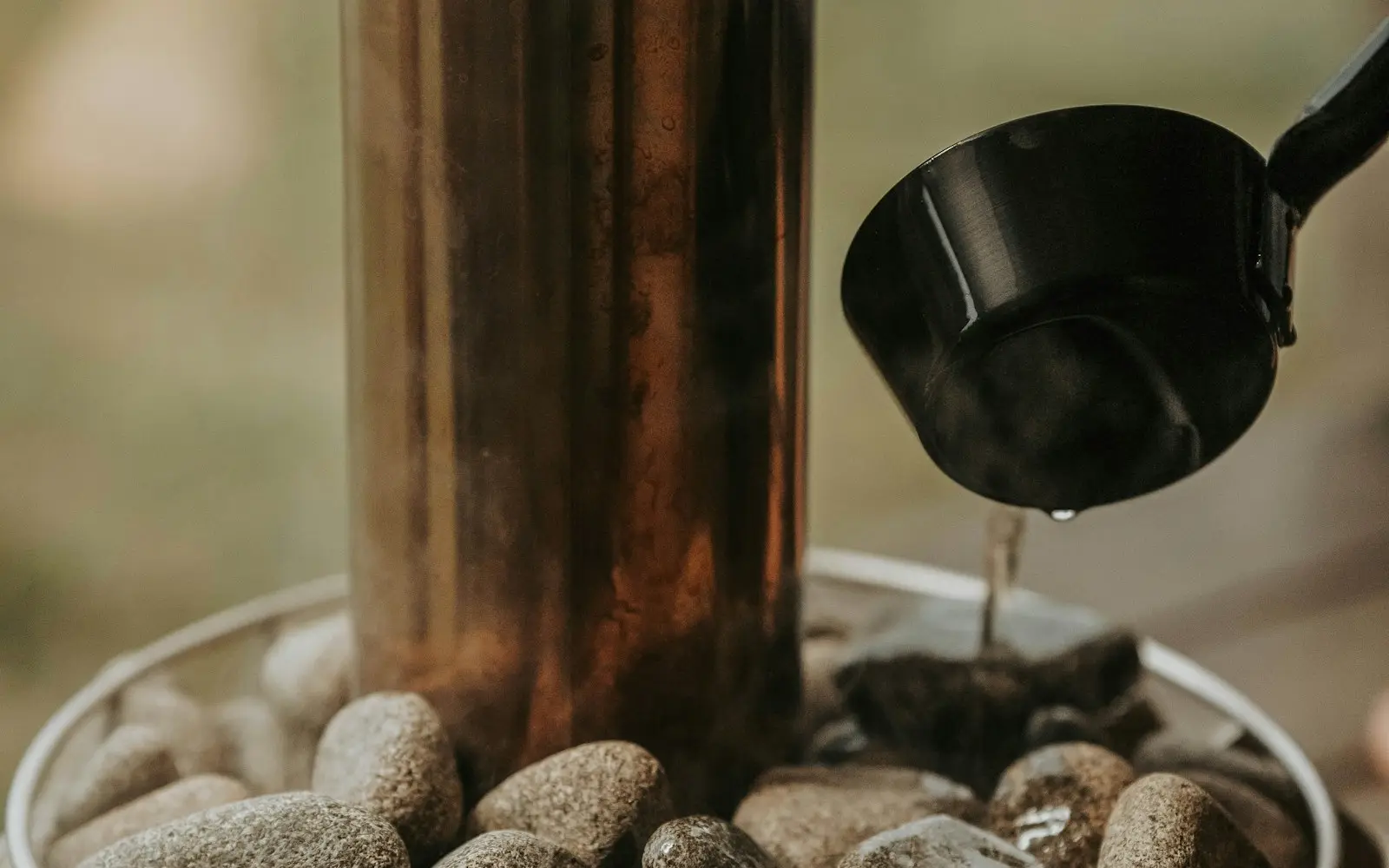
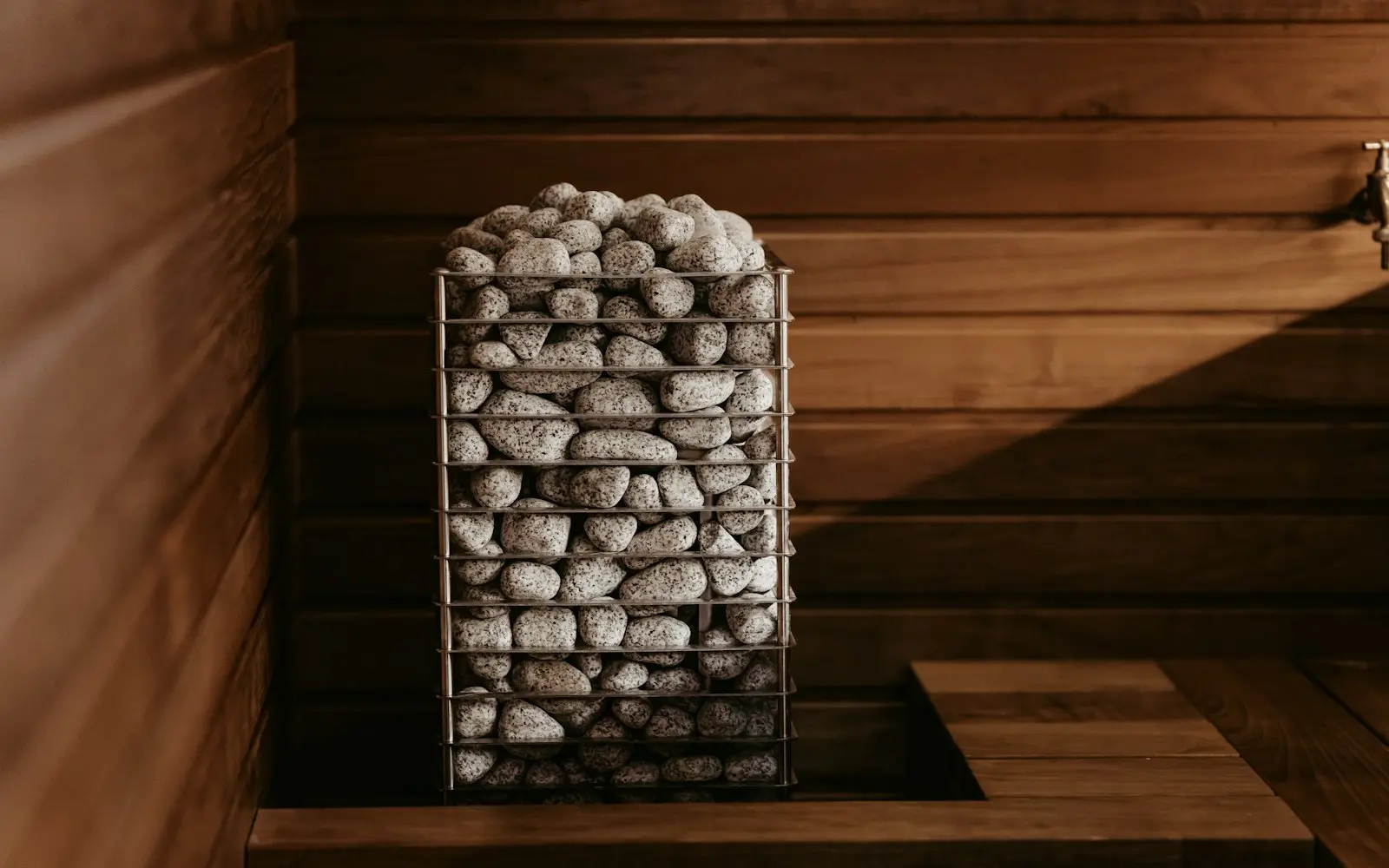
This is the classic setup. An electric heater (the kiuas) warms a basket of stones and the air around them. Between pours the room is dry: researchers describe traditional Finnish saunas as 10-20% relative humidity at 176-212°F (80-100°C), with stays of 5-20 minutes. Ladle water onto the stones and the steam hits you a moment later as a wave of heat. You control how much and how often.
Harvia’s US installation manual for its KIP wall heaters calls 160-185°F (70-85°C) a normal sauna temperature, and it shows how much the heat varies within the room: in its example, 180°F (82°C) near the ceiling above the heater means about 140°F (60°C) at upper-bench level, 120°F (49°C) at the lower bench and 100°F (38°C) at the floor. That spread is useful. A beginner can sit low while a seasoned bather sits high, in the same session.
What it takes:
- Power. A hardwired 240-volt circuit with its own breaker, installed by an electrician. In that manual, 4.5 kW, 6 kW and 8 kW heaters draw 18.8, 25 and 33.3 amps at 240 volts.
- Heat-up time. At least 30 minutes; the manual suggests 30 minutes to an hour to reach a good temperature.
- The right heater size. Heaters are rated for a range of room volumes; that manual rates its 6 kW model for 170-300 cubic feet, for example. Our sauna heater guide covers sizing.
Why we’d start here: it delivers the full experience, it’s easy to control, and it works inside a house or in the garden. It’s also the best-researched type: a 2018 systematic review calls traditional Finnish saunas the most studied to date.
Wood-fired sauna
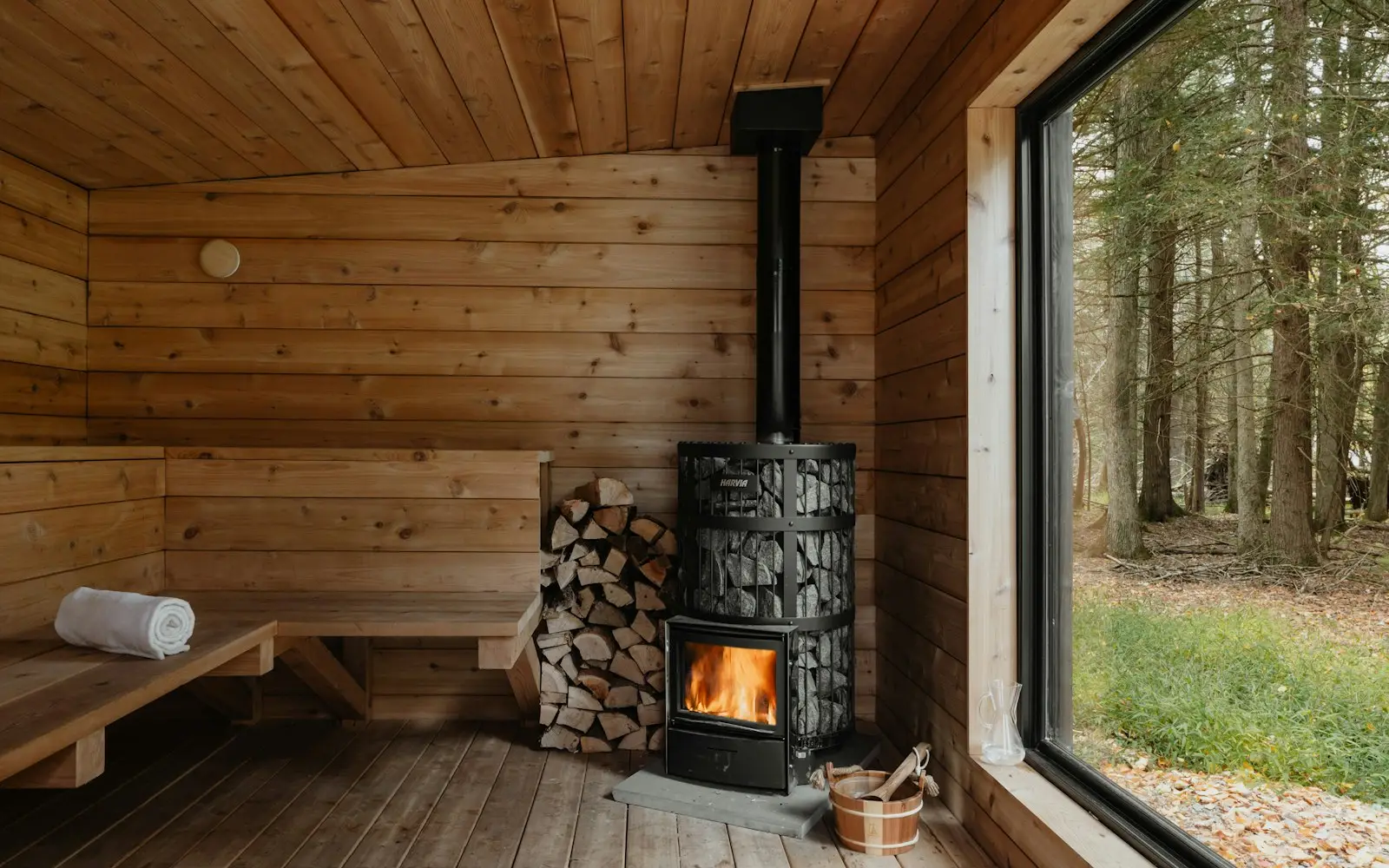
Same hot room, same steam from the stones, different fire. The Finnish Sauna Society describes two kinds of wood heater. A continuously heated stove is fired before and during bathing, with the flames and smoke routed away from the stones. A heat-storing stove is fired once, and its large mass of stones holds enough heat for the whole session; heating one usually takes a few hours.
Wood needs no electric service for heat, which makes it a natural fit for off-grid saunas. In exchange, the stove needs a proper chimney and the manufacturer’s safety distances to anything combustible, which vary from model to model. You also take on dry firewood, ash removal and chimney cleaning, and you control temperature by how you run the fire rather than by turning a dial. Plenty of people find that ritual is the whole point.
Smoke sauna
The smoke sauna (savusauna) is the oldest form of sauna. It has no chimney: smoke fills the room while the stove heats its stones, escaping first through the door and later through a hatch near the ceiling or a roof funnel. The Finnish Sauna Society says it takes a few hours, sometimes several, to heat, and advises letting the embers go out and allowing at least an hour for the smoke to clear before bathing. It recommends keeping the temperature low, 140-176°F (60-80°C), and removing leftover embers, because embers revived by water raise carbon monoxide.
The reward is a soft heat and a faint scent of smoke, resin and tar. The cost is a dedicated building, real fire-safety know-how and an afternoon of tending. If you’ve never bathed in one, try a public smoke sauna before you think about building your own.
Infrared sauna
An infrared cabin works on a different principle. Panels emit infrared radiation that warms your skin directly, so the air stays cooler, typically 113-140°F (45-60°C). There are no stones and no water, so there’s no löyly. It’s a pleasant, gentle sweat, but if you fell in love with sauna at a Finnish-style spa, an infrared cabin won’t feel like that.
Practical points:
- Power. Small cabins can run on 120 volts. Sunlighten’s 2-person Signature II, for example, needs a dedicated 120-volt, 20-amp circuit, while its 4-person Signature IV needs a dedicated 240-volt, 20-amp circuit. Plug straight into the wall; the same maker says a power strip voids its warranty.
- Warm-up. One maker says its emitters reach working temperature in 10-15 minutes, but another advises a 45-60 minute warm-up for the cabin. Either way, it isn’t instant.
- Placement. Check whether a cabin is rated for outdoor use. Sunlighten, for one, says its saunas aren’t designed to be placed outdoors.
Heater types (carbon, ceramic, full spectrum) are compared in carbon vs ceramic infrared saunas, and safety questions in infrared sauna benefits and disadvantages.
Steam room
A steam room is a sealed room fed by a steam generator. According to a technical report from wedi, which makes steam-room building panels, average temperatures sit around 100-120°F (38-49°C), and the generator fires again whenever the temperature drops, keeping the air at or near saturation. Because sweat can’t evaporate into air that’s already saturated, the room feels much hotter than its thermometer reading.
It’s a construction project as much as a purchase. Walls, ceiling and door must be sealed against vapor, the ceiling should slope about 2 inches per foot so condensation runs down the walls instead of dripping on you, and the floor slopes about 1/4 inch per foot to a drain. In a home, that usually means building it as a steam shower during a bathroom remodel. For the head-to-head comparison, see sauna vs steam room.
Portable steam and infrared saunas
Portable saunas come in two families. Steam tents pair a fabric enclosure with a small steamer. Infrared versions include sleeping-bag style blankets, domes and pop-up tents with panels in the walls. Both plug into an ordinary outlet and fold away when you’re done.
They’re the cheapest way in and the easiest to store, and the trade-offs are real: you sit on a folding chair or lie in a bag, the heat is less even, the fabric needs drying and cleaning, and there’s no löyly. We cover what separates good ones from bad ones in our guides to portable steam saunas and portable infrared saunas.
Which type of sauna is right for you?
Start with the experience you want, then check what your home can support.
- You want the sauna a Finn would recognize. A traditional sauna with an electric heater. If it’s going outdoors and you like the idea of fire, consider wood.
- You can’t add a 240-volt circuit. Look at a small infrared cabin on 120 volts, or a portable sauna. Have an electrician check your panel first, though; whether it can take another 240-volt circuit is a quick question for them.
- Very hot air isn’t for you. Try sitting on the lower bench of a traditional sauna before you rule it out; in one heater maker’s example it runs about 20°F cooler than the upper bench. If you still prefer it gentler, infrared fits.
- You’re building in the garden or off the grid. Wood-fired or electric both work outdoors. Our indoor vs outdoor sauna guide covers foundations, power runs and weather.
- You’re remodeling a bathroom and love humid heat. A steam shower makes sense.
- You rent, or want to test the habit cheaply. A portable sauna.
- It’s for two people in a small room. See choosing a 2-person sauna.
One health note: if you have a heart condition, are pregnant, or take medication that affects blood pressure or sweating, check with your doctor before using any type of sauna. Our page on who shouldn’t use the sauna has more.
Common questions
Is infrared or traditional sauna better?
Neither wins for everyone. A traditional sauna gives you hotter air, usually 160-185°F, and steam from the stones whenever you want it. An infrared cabin keeps the air cooler, around 113-140°F, and warms you with radiant heat and no water. Traditional Finnish saunas are the most studied type, and a 2018 systematic review found too little evidence to say either one is healthier. Pick the experience you will actually look forward to.
What is the difference between a wet sauna and a dry sauna?
In a traditional sauna they are the same room. Between pours the air is dry, around 10-20% relative humidity, and when you ladle water onto the hot stones you get a short burst of steam that fades as the stones reheat. A steam room is the genuinely wet option: a generator keeps the air close to 100% humidity the whole time, at a much lower temperature of about 100-120°F.
What type of sauna heats up fastest?
One infrared maker says its emitters reach working temperature in 10-15 minutes, although another large maker suggests letting the cabin warm for 45-60 minutes before a session. A traditional electric sauna needs at least 30 minutes and often closer to an hour for higher temperatures. Wood-fired timing depends on the stove, the firewood and the weather, and heat-storing stoves and smoke saunas take hours.
Does an infrared sauna use less electricity than a traditional sauna?
It usually draws less power. One major maker's 2-person infrared cabin is rated at about 2,000 watts on a 120-volt circuit, while one major maker's traditional heaters for home saunas run 3-8 kW on 240 volts. Both switch on and off to hold temperature once the room is hot, so the energy a session uses depends on room size, insulation, outdoor temperature and how long you leave it running.
Is a wood-burning sauna better than an electric one?
Not better, different. The heat and the steam from the stones are the same kind of experience. Wood adds the fire, the smell and independence from the grid, but you tend the stove, store dry firewood, clear ash and keep the chimney clean, and the stove needs a flue and model-specific clearances to anything that can burn. Electric is easier to control and is the simpler choice inside a house.
Sources
- Hussain & Cohen, Evidence-Based Complementary and Alternative Medicine: Clinical Effects of Regular Dry Sauna Bathing, a Systematic Review (2018)
- Finnish Sauna Society: The sauna heater
- Finnish Sauna Society: A good smoke sauna
- Harvia: KIP sauna heater owner's and installation manual, US edition (2023)
- wedi: Introduction to Steam Rooms and Steam Showers, technical report
- Sunlighten: Guides and spec sheets (Signature II and IV electrical requirements)
- Sunlighten: Frequently asked questions (warm-up time, dedicated circuit, outdoor use)
- Clearlight: True Wave heaters and low EMF (heater warm-up time)
We update this guide when products, standards or research change. Spot something out of date? Tell us.