Sauna vs Steam Room: Differences, Benefits and Which to Choose
Same goal, very different rooms. One runs hot and dry, the other cooler and soaking wet, and that changes how your body copes, what the research covers and what it takes to build one.
Quick answer
A sauna heats dry air to about 150-195°F (65-90°C) with humidity under 20%, while a steam room runs around 110-115°F (43-46°C) at close to 100% humidity. Steam feels just as intense because sweat barely evaporates. Saunas have far more health research behind them, are easier to keep clean, and need no plumbing at home.
On this page
A sauna heats dry air to about 150-195°F (65-90°C). A steam room runs much cooler, around 110-115°F (43-46°C), but fills the air with steam until humidity sits near 100%. Both make you sweat hard, and the steam room often feels every bit as intense despite the lower number, because your sweat has nowhere to go.
Beyond how they feel, the two differ in how much research backs them, how easy they are to keep clean and what it takes to put one in your home. Here is the side-by-side, then the detail.
Sauna vs steam room at a glance
| Traditional sauna | Steam room | |
|---|---|---|
| Air temperature | 150-195°F (65-90°C) | About 110-115°F (43-46°C) |
| Humidity | Under 20% most of the time, rising briefly with löyly | About 98-100% |
| Heat source | Electric or wood-fired heater warming a bed of stones | Steam generator outside the room |
| What your sweat does | Evaporates and cools you | Barely evaporates |
| Room construction | Insulated wooden room with a vapor barrier and vents | Fully waterproof tile or stone, sloped ceiling, floor drain, vapor-proof door |
| Long-term health research | Decades of Finnish cohort data | Very little |
| Cleaning | Dries itself with leftover heat | Warm, wet surfaces need more frequent cleaning |
| Home utilities | Electric heater on 208 or 240 volts, no plumbing | Water line, floor drain, steam generator, 208 or 240 volts |
The temperature ranges come from Cleveland Clinic for saunas and from Steamist’s steam room planning guide, which says a correctly sized generator should hold a home steam room at about 110-115°F and roughly 98% humidity. For a closer look at the numbers, see our guide to sauna temperature.
How does the heat feel different?
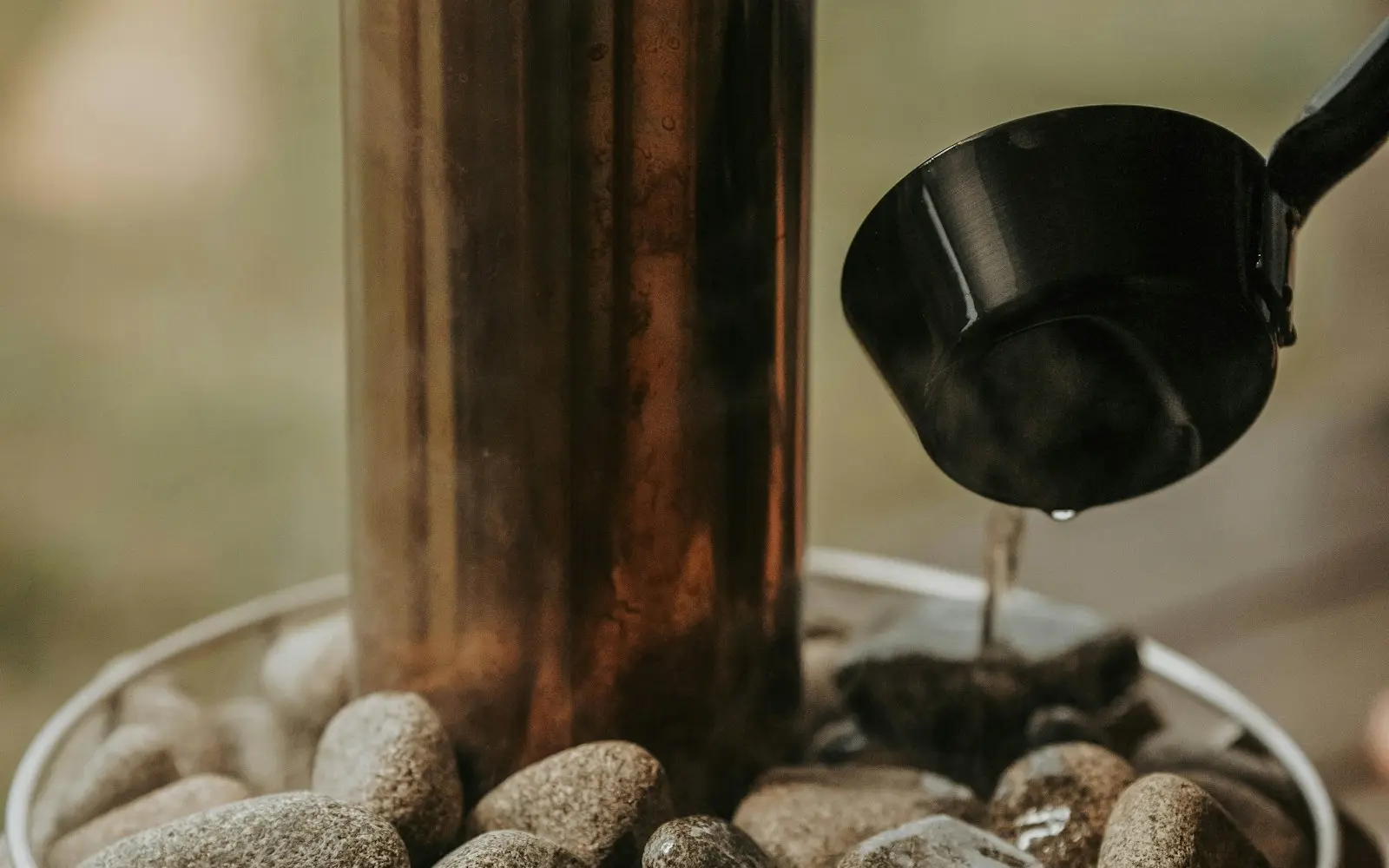
In a sauna, hot dry air lets your sweat evaporate, and evaporation is what cools you, so you can sit comfortably in very hot air for a while. When someone throws water on the stones, a burst of steam fills the room and it suddenly feels much hotter. That burst is called löyly, and you control it with the ladle.
In a steam room, the air is already saturated. Sweat barely evaporates, so it stays on your skin and runs off, and you lose most of your body’s main cooling trick. The room feels thick and soft rather than sharp, and the heat creeps up on you.
A 2014 study in Biology of Sport measured this directly. Ten healthy young men did three 15-minute rounds in a dry sauna at about 196°F (91°C) with 5-18% humidity, and a month later in a wet sauna at about 138°F (59°C) with roughly 60% humidity. The cooler, wetter room raised core temperature and heart rate more and scored higher on both of the heat-strain indexes the researchers used. Their conclusion: the humid room was more stressful for the body, even though the dry one was far hotter. The wet room in that study was hotter and less humid than a typical steam room, so read it as a demonstration of what humidity does rather than a direct steam room test.
Which has better health benefits?
The honest answer is that saunas have much more research behind them, and almost none of it compares the two directly.
Saunas. The best-known data come from Finland. A 2015 study in JAMA Internal Medicine followed 2,315 middle-aged men in eastern Finland for a median of about 21 years. Compared with men who used a sauna once a week, those who went four to seven times a week had a lower risk of sudden cardiac death, fatal heart disease and death from any cause. It is an observational study, so it shows an association, not proof that the sauna caused the difference. Men who sauna often may differ in other ways too. Still, it is the kind of long-term evidence steam rooms simply do not have. Our page on the benefits of sauna goes through the rest of the research and how strong it is.
Steam rooms. We could not find long-term outcome studies on regular steam room use. The closest evidence is on inhaling warm, humid air for colds: a 2017 Cochrane review pooled six trials with 387 people and rated the evidence low quality, unable to show a clear benefit or harm. Some people simply find steam more pleasant to breathe, and that is a fine reason to choose it, but it is a preference rather than a proven treatment.
Cleveland Clinic’s summary is fair: when it comes to dry heat versus wet heat, there is no clear indication that one is better than the other.
Skin and breathing: which is gentler?
It depends on you. The 2026 rapid review from Canada’s National Collaborating Centre for Environmental Health lists airway irritation among the reported side effects of dry sauna use, so if dry heat bothers your nose and throat, steam may feel better. Some people find saturated air heavy and hard to breathe, and a dry sauna with a gentle ladle of water suits them more.
On skin, we found no good trials showing that steam “hydrates” skin or “opens pores” in any way that lasts beyond a shower. Both rooms make you sweat, so rinse off afterward either way.
Which is more hygienic?
A dry sauna has the edge. The Finnish Sauna Society notes that the microbes typically found in saunas are mostly part of normal skin flora, that many bacteria are susceptible to heat and dryness, and that the amount of fungi and mold in a sauna depends on its humidity. A clean sauna dries itself after a wash with the heater’s leftover heat.
Steam rooms stay warm and wet, which the NCCEH review describes as an ideal environment for fungi. A study of a Turkish hammam it cites found the most fungal species on slippers, floors, the shaving area and the massage platform. The review also flags Legionella bacteria in the steam of poorly maintained steam rooms as a concern, and recommends avoiding standing or slow-flowing water in the system.
In both rooms, the shared risks are the same: athlete’s foot and plantar warts from wet floors and benches, and skin infections spread through broken skin. Showering first, sitting on a towel and wearing flip-flops outside the hot room handle most of it. More on that in should you avoid the steam room.
What does each take to build at home?
We won’t quote prices here because they change constantly, but the build requirements explain most of the cost difference.
A home sauna is an insulated wooden room with a heater, stones, benches and vents. The NCCEH review notes that a vapor barrier keeps moisture out of the walls and ceiling, and that sauna woods such as hemlock, cedar and spruce resist moisture. Electric heaters for home saunas run on 208 or 240 volts (Tylö’s range, for example), so plan on an electrician. There is no plumbing: the water for löyly comes from a bucket.
A home steam room is a waterproof room built around a steam generator. Steamist’s planning guide asks for:
- Walls, ceiling and floor fully covered in a waterproof finish such as tile or marble, with every crack and joint sealed with silicone
- A ceiling sloped at least 2 inches per foot so condensation runs off instead of dripping on you
- A ceiling no higher than 8 feet for best performance
- A vapor-proof door and skid-resistant flooring
- A floor drain for condensate and cleaning
- A steam generator sized to the room’s volume and materials, mounted somewhere serviceable and protected from freezing and moisture, never outdoors or inside the steam room
- A 208 or 240 volt supply, plus a water line to the generator
That is why a steam room fits naturally into a bathroom remodel: a tiled shower already has the drain, water and waterproofing. A sauna is the simpler project if you are starting from an empty corner or a backyard.
Which should you choose?
Choose a sauna if you like real heat with control over the steam, want the option with decades of research behind it, or want a room that needs no plumbing and dries itself.
Choose a steam room if dry heat irritates your airways, you prefer a lower air temperature, or you are already remodeling a bathroom with a tiled shower and drain.
If neither sounds right, an infrared cabin is a third option, with lower air temperatures and dry air. Our guide to which type of sauna is best compares all of them.
Whichever you pick, the same safety basics apply. Keep early sessions short, drink water, leave when you feel dizzy or unwell, and if you have heart disease, high or low blood pressure, are pregnant or take medication that affects sweating or blood pressure, talk to your doctor first. Cleveland Clinic lists all of those as reasons to check before using a sauna.
Common questions
Is a sauna or steam room better for weight loss?
Neither burns a meaningful amount of fat. What you lose is sweat. In a 2014 study, men lost about 1.6 pounds (0.72 kg) over three dry sauna rounds and about 0.8 pounds (0.36 kg) over three rounds in a humid sauna, because sweat evaporates less in humid air. That weight comes straight back when you drink, which you should.
Is a steam room better than a sauna when you have a cold?
There is no good evidence that either helps. A 2017 Cochrane review of trials using heated, humidified air for colds found the evidence low quality and could not show a clear benefit. A 2026 public health review lists respiratory infections among conditions that high heat can worsen. If you are sick, rest and skip hot rooms until you are well.
Is a steam sauna the same as a steam room?
Not quite. A steam room is a sealed, tiled room fed by a steam generator and kept near 100% humidity. A Finnish sauna becomes briefly steamy when you throw water on the stones (löyly), and a Russian banya runs wetter still. Some heaters also offer a soft sauna mode, around 140-166°F with 40-65% humidity, between the two.
Can you use a sauna and a steam room in the same visit?
Many people do, and nothing about it is unusual. Treat them as separate rounds of heat rather than one long session: cool off, drink some water and rest between rooms, and keep the total time modest. Humid heat raises core temperature faster, so it makes sense to take the steam room round shorter than the sauna round.
Which is cleaner, a sauna or a steam room?
A well-kept dry sauna is the easier room to keep clean, because heat and dryness work against most microbes and the room dries itself after use. A steam room stays warm and wet, which suits fungi and, in poorly maintained systems, Legionella bacteria. Both are fine when the operator cleans them properly and bathers shower first and sit on towels.
Sources
- Cleveland Clinic: Get your sweat on, the benefits of a sauna (2024)
- Pilch W et al.: Physiological strain in healthy men in dry and steam saunas, Biology of Sport (2014)
- Laukkanen T et al.: Sauna bathing and fatal cardiovascular and all-cause mortality events, JAMA Internal Medicine (2015)
- Singh M et al.: Heated, humidified air for the common cold, Cochrane Database of Systematic Reviews (2017)
- National Collaborating Centre for Environmental Health: Rapid review of environmental health risks and safety considerations in saunas (2026)
- Finnish Sauna Society: About the hygiene of sauna
- Steamist: Residential steambath architectural guidelines
- Tylö: Sauna heaters and controls catalog (bathing forms, temperature and humidity)
We update this guide when products, standards or research change. Spot something out of date? Tell us.