Best Wood for a Sauna: Walls, Benches and Exterior
Light, low-resin wood keeps a sauna comfortable to touch. Here is what to use where, and what never belongs in the hot room.
Quick answer
The best sauna woods are light, low-density species that stay comfortable against skin and do not bleed resin: spruce, aspen, alder, hemlock, cedar and their thermally modified versions. Use clear, knot-free boards for benches, kiln-dried tongue-and-groove for walls and ceiling, and leave the interior bare or use only sauna wax or paraffin oil. Never use pressure-treated lumber or ordinary stains inside.
On this page
The best wood for a sauna is a light, low-density species that stays comfortable against bare skin and does not bleed resin when it gets hot. Spruce, aspen, alder, hemlock and cedar all qualify, as do thermally modified versions of several of them. Pick clear, knot-free boards for the benches, kiln-dried tongue-and-groove for the walls and ceiling, and a weather-ready wood or cladding for the outside of an outdoor sauna.
What you leave out matters as much. Pressure-treated lumber, glued panels and ordinary stains or varnish do not belong in the hot room.
What makes a wood good for a sauna?
Four things, roughly in this order.
Low density, so it stays touchable. Heat moves through dense wood faster, which is why an oak bench would feel much hotter than a cedar one at the same temperature. The USDA Wood Handbook says the thermal conductivity of wood depends first on density, then moisture content and other factors. Structural softwood conducts heat at about 0.10-0.14 W/m·K, compared with roughly 1 for glass, 45 for steel and 216 for aluminum. That is why a wood bench is sittable at sauna temperatures and the heater’s steel casing is not.
Little or no resin. Pitch pockets can soften and weep in the heat. Thermory’s sauna catalogue puts it simply: sauna woods “must not overheat or release resin.”
Dry and stable. Harvia’s heater manual calls for kiln-dried softwood paneling with a moisture content no higher than 11%. Wood that goes up wet will shrink and open gaps as the sauna dries it out.
Smooth and clear where skin touches. Harvia’s US manual says to minimize knots on seating areas because knots can become very hot.
Here is how common sauna woods compare in the Wood Handbook (lower conductivity feels cooler to the touch):
| Species | Specific gravity | Conductivity at 12% moisture (W/m·K) |
|---|---|---|
| Northern white cedar | 0.31 | 0.094 |
| Western red cedar | 0.33 | 0.10 |
| White spruce | 0.37 | 0.11 |
| Eastern white pine | 0.37 | 0.11 |
| Basswood | 0.38 | 0.11 |
| Quaking aspen | 0.40 | 0.12 |
| Eastern hemlock | 0.42 | 0.12 |
| Western hemlock | 0.48 | 0.14 |
| Sugar maple (for comparison) | 0.66 | 0.18 |
| White oak (for comparison) | 0.72 | 0.19 |
The Handbook notes these values are approximate and can vary by as much as 20%, but the pattern is clear: the light softwoods and aspen conduct roughly half as much heat as oak or maple.
What is the best wood for sauna walls and ceiling?
Walls and ceiling are mostly about stability, looks and smell, because you lean on them only briefly.
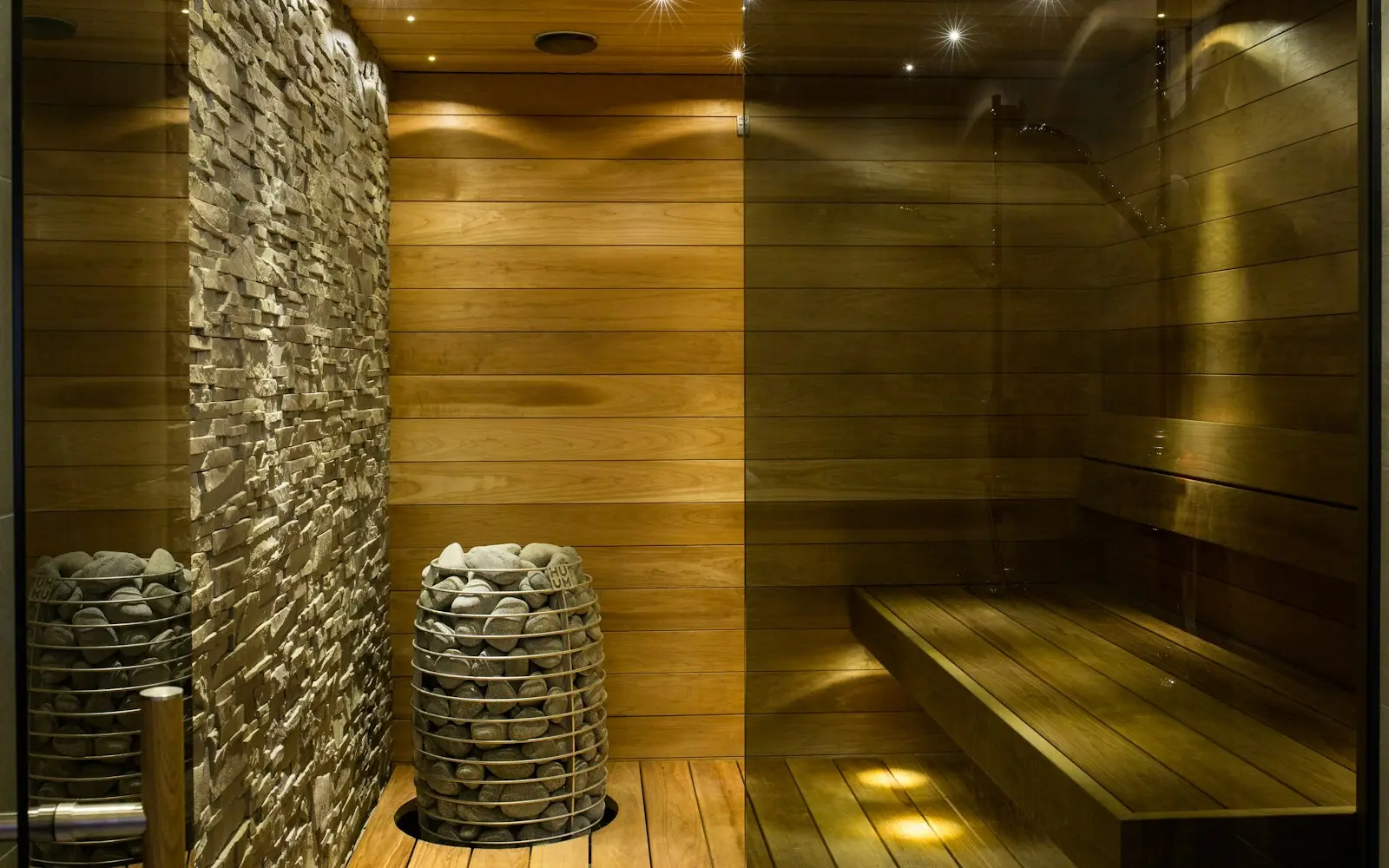
- Spruce is the classic Nordic choice; Harvia calls it one of the more traditional sauna materials. Knots are fine on walls; choose a cleaner grade if you want a calmer look.
- Aspen is pale, smooth and resin-free, according to Thermory, and works for both walls and benches.
- Alder has a warm reddish tone. Thermory describes it as water-repellent and cool to the touch.
- Hemlock is a common choice in North American sauna kits and sits between spruce and aspen on heat conduction in the table above.
- Western red cedar is the lightest wood in the table and strongly aromatic. Thermory lists it as resin-free and able to stay cool in high heat.
- Thermally modified wood (thermo-aspen, thermo-spruce and others) is heated in steam without chemicals. Thermory heats its sauna wood to about 356°F (180°C) at high pressure and says the process improves stability and moisture resistance and darkens the color.
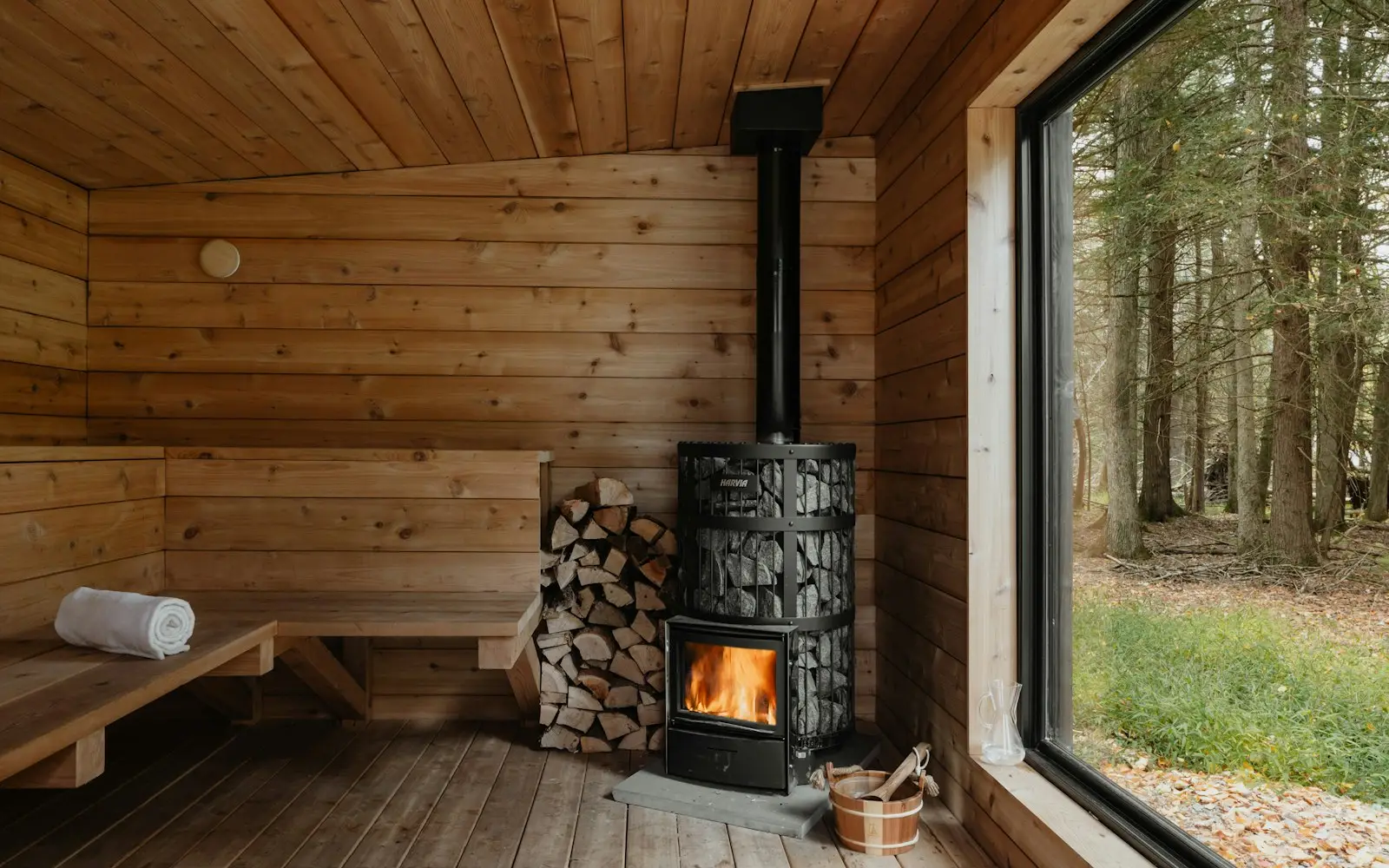
Standard paneling is 1/2 to 5/8 inch (12-16 mm) tongue-and-groove, per Harvia’s manual. It goes over insulation and a foil vapor barrier with the shiny side facing into the room, with a small vent gap behind the boards. Run the ceiling in the same wood as the walls, or a lighter one if the room feels dark.
A note on cedar sensitivity. Canada’s occupational health agency (CCOHS) lists western red cedar as a wood with a clear link to asthma, along with allergic skin reactions and eye and nose irritation. That evidence is about breathing sawdust in a workshop, not sitting in a finished room. Still, if you or a regular guest has reacted to cedar before, choose aspen, spruce or hemlock. Whatever the species, cut and sand outdoors and wear a dust mask.
What is the best wood for sauna benches?
The bench is where wood choice really shows, because you sit on it for a whole round at the hottest level of the room. Look for:
- The lowest-density wood you can get, in clear, knot-free boards. Aspen, thermo-aspen, alder, cedar and resin-free bench woods like the thermo radiata pine Thermory sells for benches all fit. Harvia notes that low-density woods are often used because they “don’t heat up too much.”
- Hidden fasteners. Harvia’s manual says to attach benches from below to prevent burns, so no hot screw heads touch skin.
- Rounded edges and a gap between boards so water drains and the wood dries fast. Harvia recommends letting benches dry fully after every use.
Thermally modified bench wood looks rich and resists moisture, but Harvia points out that heat treatment makes wood slightly more fragile and porous, and that heat-treated alder tends to absorb more moisture. It rewards a towel, regular oiling and good drying.
Whatever you choose, sit on a towel. Both Harvia and Thermory recommend a seat cover or dry towel, which also keeps sweat out of the grain. If benches still feel scorching, check the heater’s size and placement too: see our guide to choosing and sizing a heater.
What wood works on the outside of an outdoor sauna?
The exterior has a different job: shed rain and snow, handle sun, and keep its shape.
- Spruce. Harvia’s bench guide calls spruce the best choice for outdoor saunas because the resin inside protects it from moisture, and ranks it the best of the common sauna woods at handling moisture.
- Thermally modified spruce, pine and hemlock. Several outdoor kit makers build with heat-treated woods for their added stability and moisture resistance.
- Cedar. Western red cedar and eastern white cedar both show up on outdoor kits from North American makers.
Left bare, exterior wood weathers to gray. An exterior finish with UV protection holds the color longer but needs renewing, and paint needs repainting. Keep the base frame off wet ground, too: our outdoor sauna buying guide covers foundations and roofs in more detail.
Should you seal or finish the inside of a sauna?
Manufacturers do not agree on whether to treat interior wood, but they agree on what is allowed if you do.
- Leave it bare, or use a sauna-specific product. Harvia recommends paraffin oil on untreated benches once or twice a year. HUUM’s manual says wooden surfaces should be coated with sauna wax or oil to keep dirt from soaking in. Thermory recommends waxing its sauna boards and sells them pre-waxed.
- No ordinary stains, sealers, varnish, polyurethane or paint inside. Harvia’s US manual says it does not recommend stains or sealers because toxic vapors may appear when heated, and its newer manual notes that a hot heater intensifies smells like paint and glue in the air.
- Clean gently. Thermory says to wipe benches with a damp cloth, never use running water or a pressure washer, and avoid harsh disinfectants that can bleach wood. Light sanding with fine sandpaper removes sweat stains.
What wood should you never use in a sauna?
- Pressure-treated lumber inside the hot room. It is made for ground contact and weather, and the heater manuals we read call for plain wood paneling (Harvia specifies kiln-dried softwood). If a kit’s foundation plan uses treated skids or sleepers, keep them under the floor and out of the room.
- Plywood, OSB, MDF and other glued panels as interior surfaces. The manuals we read specify solid wood paneling, and Harvia notes that a hot heater intensifies smells like glue in the air.
- Dense hardwoods for benches. Oak and maple conduct nearly twice the heat of cedar or spruce.
- Knotty, sappy boards where you sit. Fine on a wall, unpleasant under your thighs.
- Green or wet lumber. Stay at or under 11% moisture content.
Wood also changes as it lives in a sauna. Thermory’s maintenance guide notes that surfaces darken over time (faster near the heater), boards can crack or warp with heat cycles, and bench screws loosen as wood swells and shrinks, so check and tighten them once a year. That is normal, and part of the character of a well-used sauna. If you are planning a full build, our home sauna buying guide puts wood in context with layout, heater and budget, and indoor vs outdoor saunas helps you decide where it goes.
Common questions
Is cedar or hemlock better for a sauna?
Both work. Western red cedar is lighter (specific gravity about 0.33 vs 0.42 to 0.48 for hemlock in the USDA Wood Handbook), so it conducts a little less heat, and it has a strong, distinctive aroma. Hemlock does not carry cedar's strong scent. If anyone in the house reacts to cedar, or you want the sauna to smell only of wood and steam, choose hemlock, spruce or aspen.
Can you use pine in a sauna?
Yes. Harvia's US heater manual lists pine alongside spruce, aspen, alder and cedar for paneling, and eastern white pine has about the same low heat conduction as spruce in the USDA Wood Handbook. Choose clear, kiln-dried boards, keep knotty or resinous pieces off the benches, and consider a resin-free bench wood such as aspen.
Is thermally modified wood safe for a sauna?
Yes. Thermal modification uses heat and steam, with no added chemicals, and makers sell it specifically for saunas. Thermory notes that thermo wood can give off a characteristic scent when heated that fades with use. Harvia points out that heat-treated wood is slightly more fragile and porous than untreated wood, so treat benches and let them dry between sessions.
How often should sauna benches be oiled?
Harvia recommends paraffin oil on untreated bench wood about once or twice a year, depending on use, and gives a simple test: if water soaks straight into the wood, it is time to re-oil. Thermory's maintenance guide says to treat wooden surfaces with a sauna product at least once a year, and more often in a sauna that gets heavy use.
Sources
- USDA Forest Products Laboratory: Wood Handbook, Ch. 4, Moisture Relations and Physical Properties of Wood (2010)
- Harvia: What to consider when choosing sauna benches
- Harvia: KIP electric sauna heater, Instructions for Installation and Use (2026)
- Harvia: KIP Owner's/Operator's Manual, US edition (2023)
- Thermory: Sauna materials product catalogue (2026)
- Thermory USA: Sauna Maintenance Guide (2024)
- HUUM: DROP 2.0 electric heater user manual, US edition
- CCOHS: Wood Dust, Health Effects (2023)
We update this guide when products, standards or research change. Spot something out of date? Tell us.