Best Outdoor Saunas: How to Choose a Backyard Sauna
The shape gets the attention, but the foundation, roof, heater and wiring decide whether a backyard sauna is a joy every winter or a project that never quite works.
Quick answer
The best outdoor home sauna is one sized for how many people will actually use it, built from stable, weather-ready wood, set level on a drained base, and fitted with a heater matched to its volume and glass. Barrels are simple and quick to build, cubes and cabins give more headroom and glass, and prebuilt saunas skip assembly but need a forklift or crane.
Some links on this page are affiliate links. If you buy through them we may earn a small commission at no extra cost to you. It never decides what we recommend. How we choose.
On this page
- Barrel, cube, cabin or custom: which outdoor sauna shape is best?
- What wood should an outdoor sauna be made of?
- What roof and weather protection do you need?
- What should an outdoor sauna sit on?
- Electric or wood-burning heater for an outdoor sauna?
- How do you get power to a backyard sauna?
- Glass and porches: worth it?
- Kit or prebuilt: how will it arrive?
- How much does an outdoor sauna cost?
- How do you maintain an outdoor sauna?
- How we chose
- Our picks
- Common questions
The best outdoor home sauna is the one that fits how many people will really use it, is built from stable, weather-ready wood, sits level on a base that drains, and has a heater matched to its volume and glass. Get those right and the shape (barrel, cube or cabin) becomes a matter of taste and budget.
Plan the unglamorous parts before you fall for a photo: where the sauna goes, what it sits on, how power gets there, and how it will arrive. If you are still deciding whether it belongs in the yard at all, start with indoor vs outdoor saunas.
Barrel, cube, cabin or custom: which outdoor sauna shape is best?
| Shape | Strengths | Trade-offs |
|---|---|---|
| Barrel | Quick to build, round staves shed water, compact volume to heat | Height is set by the diameter; curved walls limit bench layouts |
| Cube or pod | Straight walls, more headroom, often a full glass front | Glass adds heater load; flat-roof designs need good roofing |
| Cabin | Room for a porch or changing room, most layout freedom | Bigger footprint and more framing |
| Custom or DIY | Built to your site, size and heater | Design, insulation and code are on you |
Barrels are the classic backyard kit. The staves lock together, the cradles carry the weight, and a good kit goes up in an afternoon. Their limit is geometry: a barrel’s interior height can never exceed its diameter. Almost Heaven’s 6 x 6 foot Pinnacle lists 69 1/4 inches of interior height, while Thermory’s Large 60 is 7.26 feet across inside. A bigger diameter means you can sit higher, where the heat is.
Cubes and pods use straight walls, so the whole floor area is usable and the upper bench can sit higher. SaunaLife’s CL5G, for example, has 74.8 inches of interior height on a footprint about the size of a small barrel. Many have a full glass front, which looks wonderful and needs a bigger heater.
Cabins add space for a covered porch or a changing room, which matters more than you might think in January.
Custom builds let you size everything to the site. The room itself follows the same rules as an indoor sauna: insulation, a foil vapor barrier and kiln-dried paneling. Our sauna wood guide covers what to use.
What wood should an outdoor sauna be made of?
Outdoors, wood has to handle sun, rain and freeze-thaw on one side and sauna heat on the other. Common choices:
- Thermally modified spruce, pine or hemlock. Thermory heats its sauna wood to about 356°F (180°C) in steam and pressure, with no chemicals, and says the process improves durability, stability and moisture resistance. Redwood Outdoors heat-treats Canadian hemlock above 400°F (204°C).
- Cedar. Western red cedar and eastern white cedar both appear on outdoor kits from North American makers.
- Spruce. Untreated Nordic spruce is the traditional sauna wood and remains common.
Left bare, any of them weathers to gray or silver. Thermory recommends a penetrating oil with a UV inhibitor if you want to keep the original color, or occasional washing if you like the silver look. Painted exteriors look sharp but will need repainting in time.
What roof and weather protection do you need?
Most outdoor saunas shed water in one of three ways:
- A shingle kit over the roof boards, often with drip edges. SaunaLife’s CL5G includes one, and Redwood Outdoors includes asphalt shingles on its barrels.
- A fitted membrane. Thermory’s barrels use a “rain jacket,” a waterproof PVC roof cover stapled along the edges.
- A pitched or slanted roof with gutters or a rainwater system, common on cabins and modern cubes.
Wherever water runs off, make sure it drains away from the base. In snow country, clear heavy snow off the roof: Thermory’s barrel instructions say to do so to prevent damage from its weight, and to avoid damaging the roof covering while you do it.
What should an outdoor sauna sit on?
A level, solid, well-drained base. This is the single most common thing people underestimate.
- Concrete pad or footings. Thermory calls concrete ideal. Redwood Outdoors accepts a full pad or concrete footings under each cradle.
- Compacted gravel. Both makers list crushed or compacted gravel. Build it up so water drains away rather than pooling.
- Pavers or a stone patio, set level.
- A solid deck or reinforced platform that can carry the full weight.
Weight adds up fast: Redwood Outdoors’ 6-person barrel is 1,190 lb, SaunaLife’s CL5G cube 1,680 lb and its prebuilt G6 2,756 lb, before people and stones. Redwood Outdoors says the base must support the full weight of the sauna and everyone in it.
Thermory’s installation guide adds three details worth copying for any sauna: set the base frame above ground level, put a water-resistant layer such as bitumen strips between frame and base, and make sure the site is level and free of standing water after rain. If the base settles out of level, the door will stop closing properly.
Electric or wood-burning heater for an outdoor sauna?
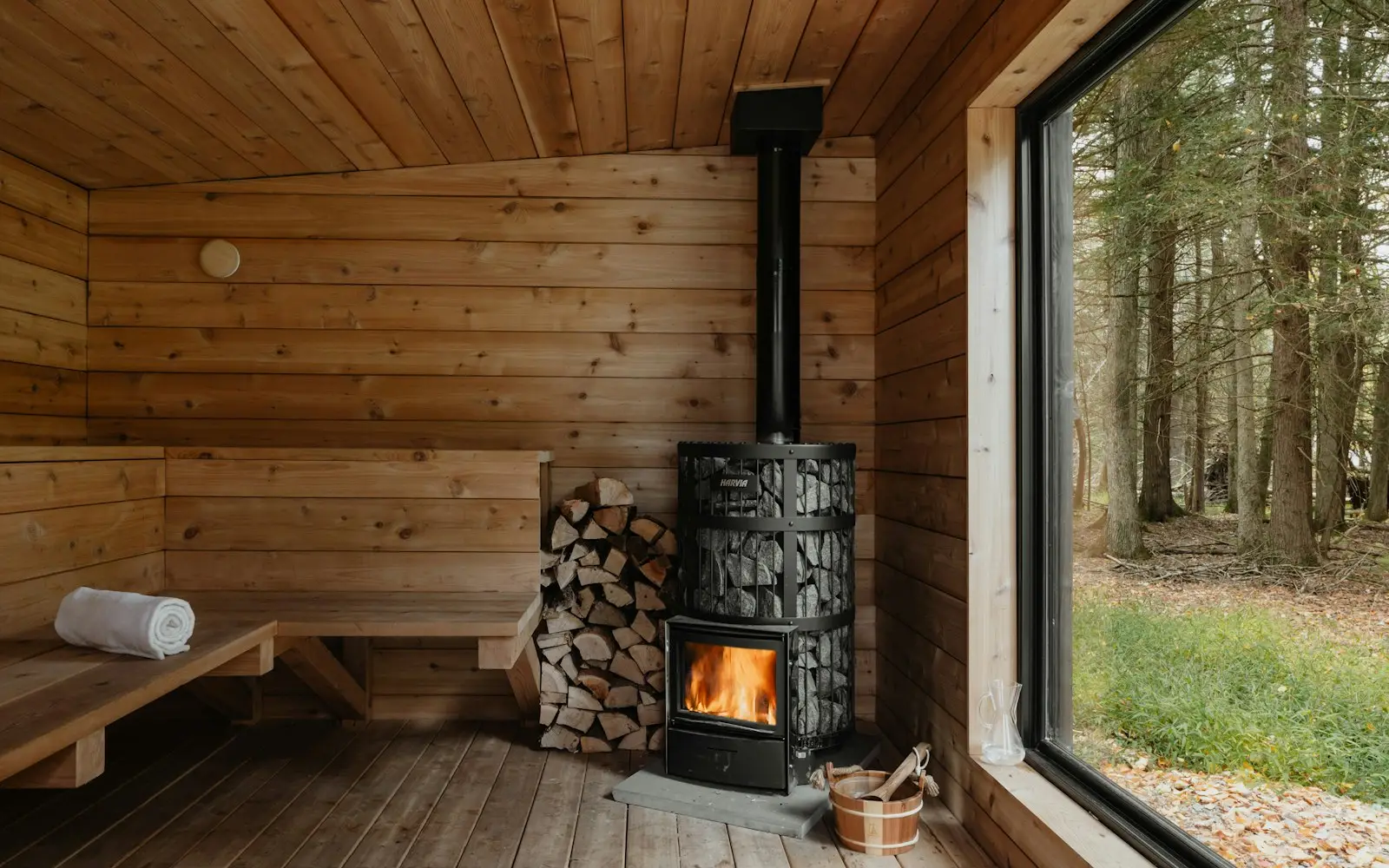
Both work outdoors. Electric is the easy daily choice: a 6-9 kW heater on a 240 V circuit, often with a phone app that lets you start the sauna from the kitchen. Wood needs no big electrical run and gives you fire and crackle, but adds a chimney, large clearances, firewood and a longer lead time before each session.
Size the heater for the room including its glass. HUUM’s manual adds 3.3 cubic feet to the room volume for each square foot of uninsulated glass, brick or tile. Thermory’s Large 60 is a good example: 265 cubic feet plus a 7 x 3.5 foot window (24.5 square feet) sizes like about 346 cubic feet, comfortably inside the 283-460 cubic foot range HUUM gives its 9 kW DROP. Our sauna heater guide walks through sizing, stones and wood stove requirements in detail.
How do you get power to a backyard sauna?
An electric sauna needs a dedicated 240 V circuit run from your panel to the sauna, hardwired to the heater. The kits we checked list 30 A for a 6 kW heater and 40 A for 8 kW (Redwood Outdoors), and Almost Heaven’s Pinnacle lists a 240 V, 30 A hardwired heater plus a separate 120 V, 15 A plug-in circuit for lighting. Bigger heaters need bigger breakers and wire.
Have a licensed electrician plan the run before you pour the base. Thermory and Redwood Outdoors both say a certified electrician must make the heater connection. The electrician should plan the route, burial depth and conduit to your local code and pull the permit. Keep controls and contactors somewhere dry: Thermory notes that HUUM’s UKU control can be mounted outside only in a dry spot that stays under 104°F (40°C).
Then call your building department. Rules on setbacks, accessory-building size, electrical permits and wood stove chimneys vary from town to town, and an HOA may add its own.
Glass and porches: worth it?
Glass turns a sauna into a view, and a glass-front cube facing trees or water is a lovely thing. It also costs heat: every square foot of glass adds volume to your heater calculation, and a big west-facing pane can make the room hot and glary on summer afternoons. Look for tempered glass (SaunaLife’s G6 uses a double-glazed tempered front wall) and think about privacy from neighbors before you choose the orientation.
A porch gives you a dry spot to open the door in rain or snow, a place to hang towels and somewhere to sit and cool down between rounds. Many barrels and cabins offer one as an option, and it is the upgrade we’d prioritize over extra glass.
Kit or prebuilt: how will it arrive?
Kits arrive on a pallet or in a crate and go together with basic tools. Thermory says its barrels take 4 to 6 hours with two or three people with moderate DIY skills, and Redwood Outdoors says a few hours. The staves, panels and hardware are precut, so the real work is the base and the wiring.
Prebuilt saunas arrive in one piece. SaunaLife’s G6 ships fully assembled at 2,756 lb and needs a forklift or crane to come off the truck, with shipping dimensions of 86 x 98 x 100 inches. Walk the route from street to site before you order: gates, slopes, soft lawn, fences and overhead wires all matter.
How much does an outdoor sauna cost?
As of late 2026, the barrel kits we checked that include an electric heater listed between about $5,300 and $7,600, and one major US maker’s four-person cube and larger outdoor models listed from about $9,900 to almost $28,000. Sale prices move often, so treat these as a rough guide. Budget separately for delivery, the foundation, the electrician and permits, and any porch, glass or heater upgrades.
How do you maintain an outdoor sauna?
Most upkeep is quick if you do it routinely. From Thermory’s maintenance guide and FAQ:
- After each use: wipe the benches with a damp cloth, take out wet towels, and dry the room by leaving the heater on for about half an hour with the vent open.
- Never hose down or pressure-wash the inside, use harsh disinfectants, or dry laundry in the sauna.
- At least once a year: treat interior wood with a product made for saunas, tighten bench screws (wood swells and shrinks), and check the heater stones.
- Outside: wash occasionally, refresh any UV oil or paint, clear snow, keep gutters and drainage clear, and check the roof covering.
Thermory’s instructions also cap its barrels’ hot room at 194°F (90°C), and its maintenance guide warns that heating past the heater maker’s maximum can warp the wood or create a fire hazard. For the bigger picture on budget, layout and timeline, see our home sauna buying guide.
How we chose
We looked for outdoor saunas whose makers publish real specs on their own product pages: interior dimensions, wood species, wall or stave thickness, roof type, weight and delivery format. We wanted one of each main approach (a traditional cedar barrel, a thermally modified barrel, a glass-front cube kit and a fully assembled sauna) and left out models we could not verify on a current product page or that were listed as out of stock when we checked. We link only to manufacturers’ own pages, and every spec above comes from them.
Our picks
We do not accept free products or payment for placement. Some links are affiliate links, so we may earn a small commission if you buy, at no extra cost to you.
Best for a classic cedar barrel for up to four
Almost Heaven Pinnacle 4 Person Barrel Sauna
A 6 x 6 foot barrel with an interior of about 75 x 63 inches, built from 1 3/8-inch ball-and-socket lumber in a Rustic Red Cedar option, with USA listed as country of origin. Heater choices are a 6 kW Harvia KIP with dials or smart heater packages with a Fenix control, and the page spells out the electrical: 240 V, 30 A, hardwired for the heater, plus a 120 V, 15 A plug-in circuit for lighting.
Watch for: Interior height is 69 1/4 inches, lower than the cubes and cabins here, and the page lists no wood-burning heater option for this model.
See it at almostheaven.comBest for a thermally modified barrel with a heater included
Thermory Natural Barrel Sauna, Large 60
Built from 1.57-inch thermally modified Nordic spruce with staves arranged to reduce water trapping. It is 7.26 feet across inside with 265 cubic feet of volume for four to six people, and Thermory includes a 9 kW HUUM Wi-Fi heater and a rain jacket roof cover. A porch and an extra-wide window are options.
Watch for: Thermory does not list prices on the page, and the rain jacket is a stapled waterproof PVC cover, not shingles. A 9 kW heater is a large electrical load, so have an electrician confirm your panel can carry it.
See it at sauna.thermoryusa.comBest for a compact glass-front cube kit
SaunaLife Model CL5G cube sauna
Straight walls give a tall interior (about 77 x 55 inches and 74.8 inches high) for up to four. The walls are 42 mm thermo-spruce with thermo-aspen seating, the roof comes with a full shingle kit and drip rails, and the front door is 8 mm tempered bronze glass. Foundation beams and a Wi-Fi LED light bar are included.
Watch for: No heater is listed on the product page, so you choose and size one separately, with the glass door counted in the volume. At 1,680 lb it needs a solid, level base.
See it at saunalife.comBest for a fully assembled sauna with a glass front
SaunaLife Model G6 outdoor sauna
It arrives built, so there is no kit to assemble. SaunaLife lists 7 1/16-inch walls for insulation and sound, a Thermo-Aspen interior with upper and lower benches, black-painted Thermo-Pine cladding, a slanted roof with a rainwater control system and a double-glazed tempered glass front wall. Outdoor control and electrical boxes come with it.
Watch for: At 2,756 lb it needs a forklift or crane to come off the truck, and a clear path to its base. The page lists no heater model, and its capacity is given as up to 5 in the headline and up to 6 in the features.
See it at saunalife.com
Common questions
Can an outdoor sauna sit on gravel?
Yes, if the gravel is compacted, level and drains well. Thermory lists crushed gravel, pavers and a well-built deck as workable bases and calls concrete ideal, and Redwood Outdoors also accepts compacted gravel or concrete footings under each barrel cradle. Whatever the base, keep the sauna's frame off the soil and make sure no water stands around it after rain.
Do you need a permit for an outdoor sauna?
It depends on where you live. Before you order, call your local building department with the sauna's footprint, height and heater type. They can tell you about setbacks, size limits for accessory buildings, and whether the 240 V circuit or a wood stove chimney needs a permit and inspection. If you have a homeowners association, check its rules too.
How long does it take to put together an outdoor sauna kit?
The building itself is often a day. Thermory says its barrels take 4 to 6 hours for two or three people with moderate DIY skills, and Redwood Outdoors says a few hours with basic tools. Budget extra days for the foundation before delivery and for the electrician afterward, and remember that a prebuilt sauna arrives assembled but needs a forklift or crane.
Can you use an outdoor sauna in winter?
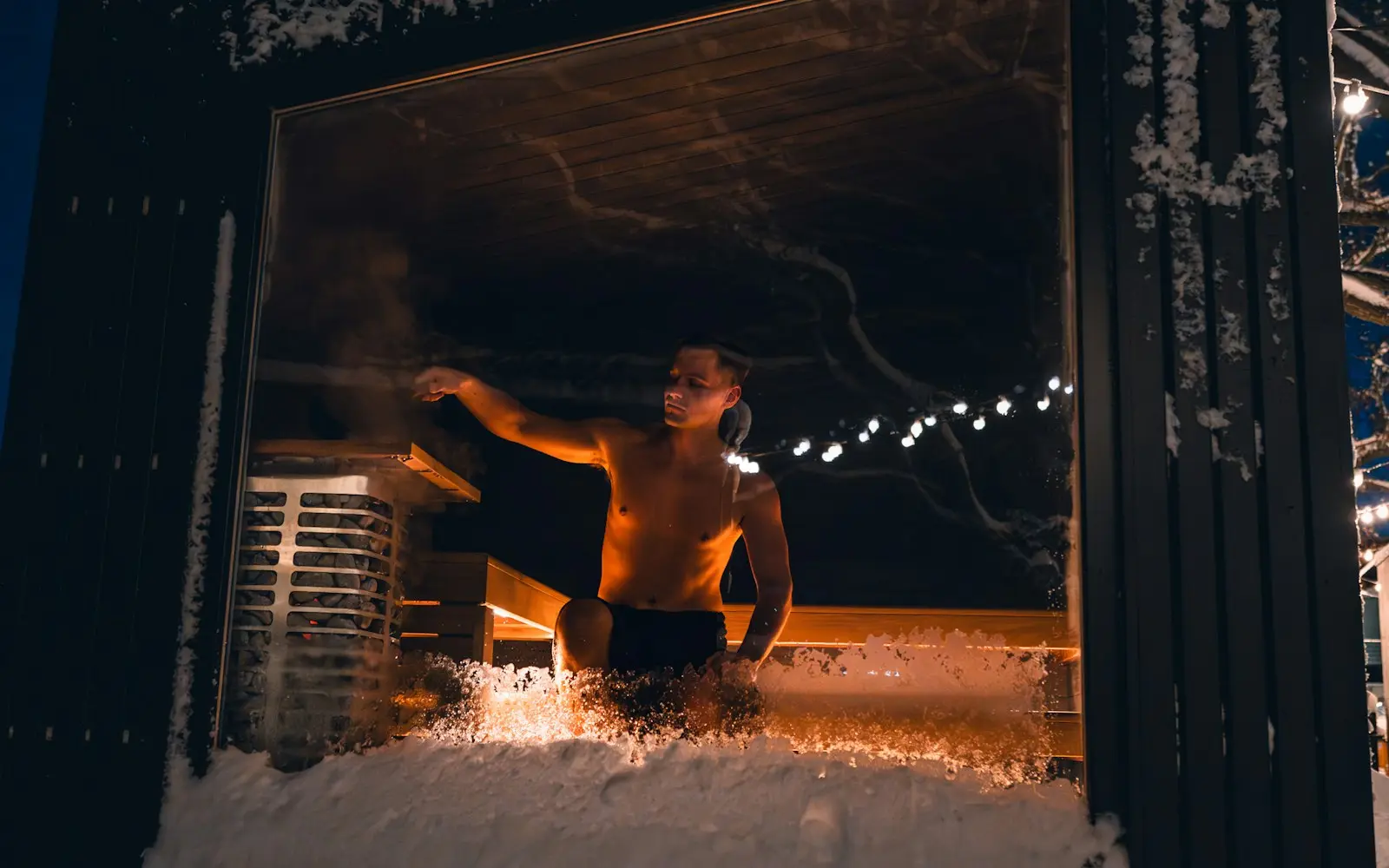
Yes. Outdoor saunas are built for year-round use, and a snowy cool-down between rounds is one of the joys of owning one. Size the heater with the room's glass included so it keeps up on cold days, keep the controls somewhere dry, and clear heavy snow off the roof. Thermory's barrel instructions say to remove snow from the roof so its weight does not damage the sauna, taking care not to tear the roof covering.
Sources
- Thermory USA: Sauna resources and FAQ
- Thermory USA: Barrel installation guide, No. 60 and 61 (2026)
- Thermory USA: Sauna Maintenance Guide (2024)
- Thermory: Sauna materials product catalogue (2026)
- Redwood Outdoors: Extra-Wide Outdoor Barrel Sauna, 6 Person
- Thermory USA: FAQs
- Almost Heaven Saunas: outdoor sauna range
- HUUM: DROP 2.0 electric heater user manual, US edition
We update this guide when products, standards or research change. Spot something out of date? Tell us.