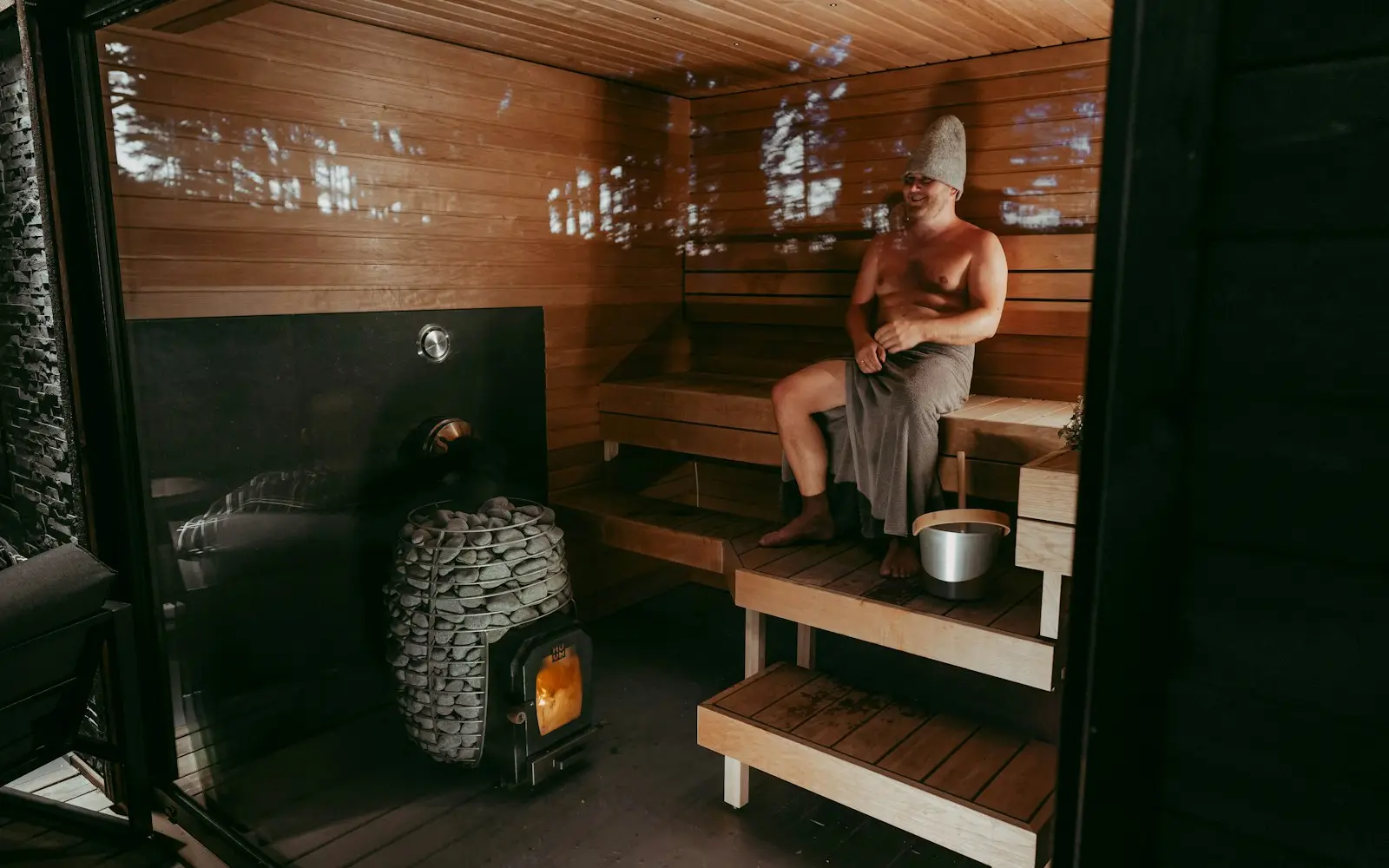
Should You Drink Water While in the Sauna?
How much you really sweat, how much to drink before, during and after, when electrolytes help, and what alcohol and coffee do.
Quick answer
Yes. Sipping water between rounds, or during a long session, is the simplest way to keep up with what you sweat out. Studies measured average losses of about 12 to 24 ounces (0.4 to 0.7 L) per visit, and some people lost far more. Arrive hydrated, sip as you go, drink a few glasses afterward, and skip alcohol.
On this page
- How much do you sweat in a sauna?
- How much water should you drink before a sauna?
- Should you drink during the sauna?
- How much should you drink after a sauna?
- Do you need electrolytes after a sauna?
- What are the signs of dehydration?
- Is it safe to drink alcohol in the sauna?
- Does coffee or caffeine dehydrate you before a sauna?
- Common questions
Yes, drink water while you’re in the sauna, or at least between rounds. A review of sauna and body fluid balance concluded that the most convenient and effective way to replace what you sweat out is small drinks, repeated often, during the bathing itself. There’s nothing to gain by holding off.
How much you need depends on how long you stay and how much you sweat. Studies that weighed people before and after a sauna found average losses of about 0.8 to 1.6 pounds, which is roughly 12 to 24 ounces of fluid (0.4 to 0.7 L). Some people lost far more. Here’s how to keep up, before, during and after.
How much do you sweat in a sauna?
More than most people expect. Harvard Health says the average person pours out about a pint of sweat (16 ounces, about 470 mL) during a short stint in a sauna. Studies that measured it directly found similar numbers:
| Study | Sauna and time | Average loss |
|---|---|---|
| 674 students aged 19-20 (Podstawski et al., 2014) | Dry sauna at 194°F (90°C), two 10-minute rounds | Women: 0.8 lb (about 12.5 oz of fluid). Men: 1.1 lb (about 17 oz) |
| 10 men aged 25-28 (Pilch et al., 2014) | Dry sauna at about 196°F (91°C), three 15-minute rounds | 1.6 lb (about 24 oz) |
| Same 10 men (Pilch et al., 2014) | Humid steam bath at about 138°F (59°C), three 15-minute rounds | 0.8 lb (about 12 oz) |
| 12 healthy adults (Jenkins et al., 2026) | Infrared sauna at 149°F (65°C), 45 minutes | Sweat rate of about 47 oz (1.4 L) per hour |
The averages hide a wide range. In the study of 674 students, individual losses ran from about 0.2 pounds to 2.9 pounds after just 20 minutes of heat, and bigger bodies lost more: overweight and obese students lost the most, and men lost more than women. The authors concluded that people with a higher BMI are at greater risk of dehydration and should pay particular attention to replacing fluids during a sauna visit.
A useful rule from that paper: one kilogram of body weight lost in the sauna corresponds to roughly one liter of sweat. In US units, that’s about 15 fluid ounces for every pound.
Infrared rooms are cooler, but don’t assume they’re dry work. The 2026 infrared study above measured a sweat rate of 1.4 liters per hour at 149°F. And a steam room’s smaller weight loss doesn’t mean it’s easier: in the same men, the humid steam bath raised core temperature and heart rate more than the hotter dry sauna did. Our sauna vs steam room comparison explains why.
How much water should you drink before a sauna?
Arrive already well hydrated rather than trying to chug a bottle at the door. The NHS’s simple check is to drink enough through the day that your pee is a pale color.
A glass or two of water in the hour or two before is a sensible habit. For reference, the students in the Podstawski study were told to drink at least 1 liter (34 oz) of water the day before and 0.5 liters (17 oz) two hours before their sauna.
If you’re coming straight from a workout, drink first. The Finnish review of sauna and fluid balance notes that after heavy physical activity, you may need to replace fluid before bathing, not just after. Our guide to using the sauna after a workout covers that combination.
Should you drink during the sauna?
Yes. Small sips between rounds, or during a longer session, are the easiest way to keep pace. That’s exactly what the fluid-balance review recommends: small amounts, repeated frequently, while you bathe.
In practice, that might look like a few mouthfuls or half a glass of water during each cool-down break. If you’re doing several rounds, or the room is very hot, drink a little more.
One thing water can’t do is make an overlong session safe. If you feel dizzy, sick or unwell, leave the heat. Drinking on the bench is not a reason to stay in longer. Our guide to how long to stay in the sauna has the numbers and warning signs.
How much should you drink after a sauna?
Harvard Health recommends drinking two to four glasses of cool water after each sauna. That lines up well with the measured losses above for a typical visit.
If you want to be precise, weigh yourself before and after. Every pound you lost is about 15 ounces of fluid to put back. You don’t have to drink it all at once: sip steadily over the next hour or two, and your next meal will add more fluid and salt.
And remember, the number on the scale after a sauna is water, not fat. It comes back when you drink, as it should. Our page on whether the sauna burns fat explains the difference.
Do you need electrolytes after a sauna?
For an ordinary sauna, usually not. Sweat is mostly water with some salt, and a normal meal after your sauna replaces the salt. The authors of the 2014 sauna study note, citing earlier research, that people eating a normal diet don’t need electrolyte supplements, apart from the first hours of exposure to a hot environment.
An electrolyte drink can make sense when you’ve sweated a lot: long sessions, many rounds, a sauna on top of a hard workout, or a hot day. Water is still the default.
If you’ve been told to limit fluids or salt, for example because of heart failure or kidney disease, ask your doctor how sauna fits with that before you start. Our page on who shouldn’t use the sauna covers other health conditions.
What are the signs of dehydration?
The NHS lists these symptoms of dehydration in adults:
- Feeling thirsty
- Headache, or feeling dizzy or lightheaded
- Dark yellow, strong-smelling pee
- Peeing less often than usual
- Feeling tired
- A dry mouth, lips and tongue
- Sunken eyes
If you notice these after a sauna, cool down and drink water. If you feel sick, start with small sips. The NHS advises getting urgent medical advice if you feel dizzy when you stand up and it doesn’t go away, if you’re peeing much less than normal, or if you’re breathing fast or have a fast heart rate. Confusion, difficulty breathing, or skin that turns blue, gray, pale or blotchy needs emergency care.
Is it safe to drink alcohol in the sauna?
No. Skip alcohol before and during the sauna. Harvard Health advises avoiding alcohol before and after a sauna.
The risk isn’t theoretical. A study of deaths in Finnish saunas from 1990 to 2002 found them to be rare, fewer than 2 per 100,000 people a year, but half of the people who died had been drinking. The authors concluded that prevention should focus on drinking less and not leaving a drunk bather alone in the sauna.
If you want a drink, have it well after your sauna, once you’ve cooled down and had plenty of water first.
Does coffee or caffeine dehydrate you before a sauna?
Not much, if you’re a regular coffee drinker. In a 2014 study, 50 men who usually drank 3 to 6 cups of coffee a day drank four 200 mL servings of coffee (about 27 oz in total) daily for three days, and the same amount of water daily in a separate three-day trial. Their hydration markers were the same either way, and the authors concluded that moderate coffee hydrates about as well as water in habitual drinkers.
So your morning coffee isn’t a problem before a sauna. For rehydrating afterward, though, plain water is the better choice; the NHS advises avoiding caffeinated drinks when you’re dehydrated.
If you’re new to the whole routine, our first-timer’s guide to using a sauna puts hydration in context with everything else.
Common questions
Why do I get a headache after the sauna?
Dehydration is a common cause. The NHS lists headache and feeling lightheaded among the symptoms of dehydration. Drink water, cool down and rest. Next time, drink before you go in, sip between rounds, and keep rounds shorter. A headache that won't go away or comes with confusion needs medical help.
Is it bad to drink cold water after a sauna?
No. Harvard Health specifically suggests drinking two to four glasses of cool water after each sauna. Drink at whatever temperature you find easiest to get down. If you feel queasy, the NHS suggests starting with small sips and gradually drinking more.
Does the weight you lose in a sauna come back?
Yes, because it's water. One kilogram of weight lost in the sauna corresponds to roughly one liter of sweat, so about 15 ounces of fluid per pound. It returns as soon as you drink and eat normally, which is exactly what you should do. Sauna doesn't cause meaningful fat loss.
Can you bring a water bottle into the sauna?
At home, yes, and many public saunas allow it too, though some ask you to keep drinks outside. A plastic or insulated bottle is a better choice than glass on hot, wet benches. Even if you can't bring it in, keep it within reach for your breaks between rounds.
Sources
- Podstawski et al., ScientificWorldJournal: Sauna-induced body mass loss in young sedentary women and men (2014)
- Pilch et al., Biology of Sport: Physiological reactions and strain in dry and steam heat saunas (2014)
- Jenkins et al., Experimental Physiology: Far-infrared sauna exposure at 65°C elevates core temperature (2026)
- Ahonen and Nousiainen, Annals of Clinical Research: The sauna and body fluid balance (1988)
- Harvard Health Publishing: Sauna health benefits: are saunas healthy or harmful? (2020)
- NHS: Dehydration (reviewed 2026)
- Killer, Blannin and Jeukendrup, PLoS One: No evidence of dehydration with moderate daily coffee intake (2014)
- Kenttämies and Karkola, Journal of Forensic Sciences: Death in sauna (2008)
We update this guide when products, standards or research change. Spot something out of date? Tell us.